Kept Unread
A negative from 1946 that could be interpreted by no one for fifty-seven years. Until a hand tried, and afterwards, a machine.
A summary. The full essay appears on Substack.
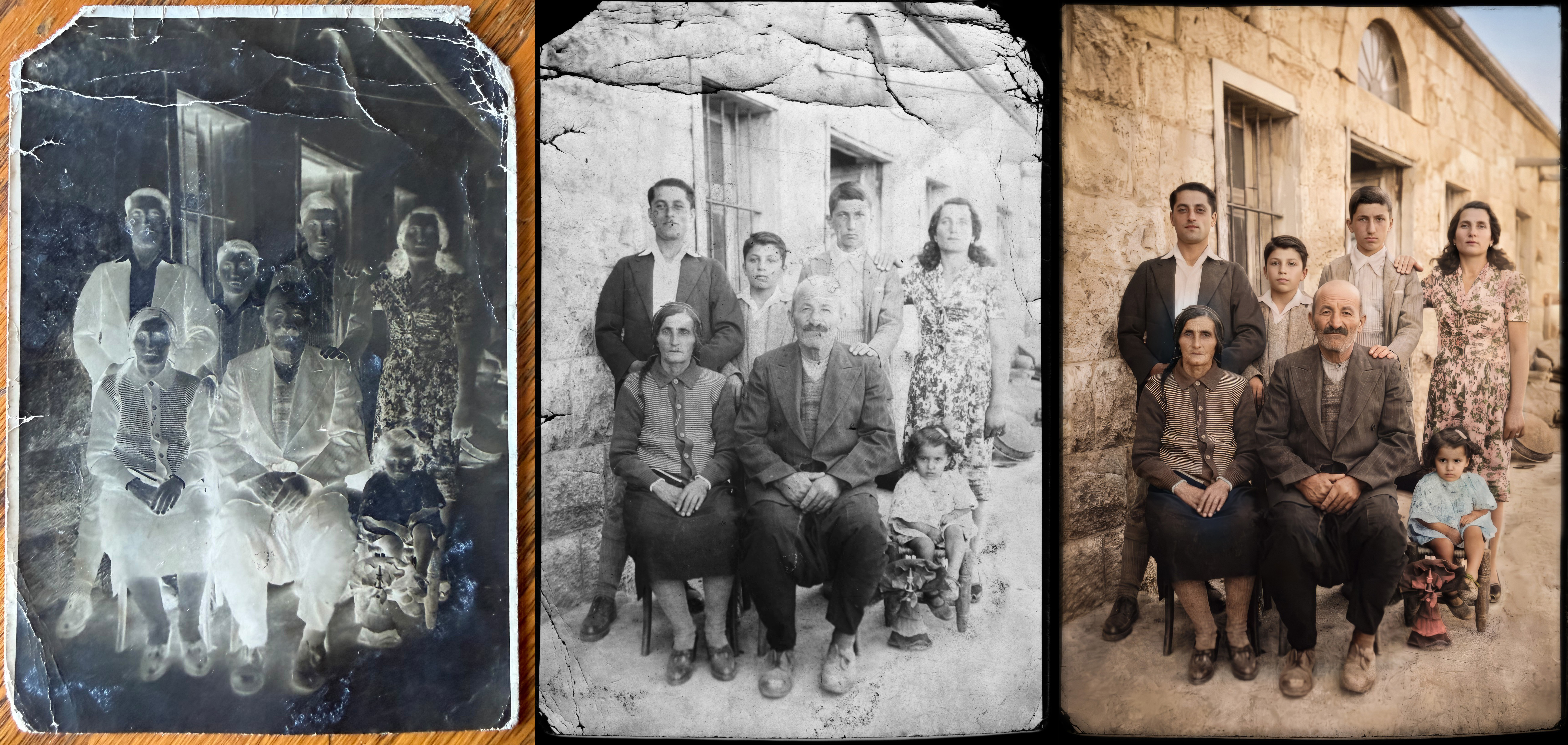
In 1946 a photographer working a circuit through the villages of the Bekaa ran out of glass plates at Kfar Mechkeh and exposed photographic paper directly instead. What he handed the Nasrallah family was a negative: an intermediate state, the half-product a studio keeps in a folder until it prints from it. Seven silhouettes on a terrace, the shadows falling the wrong way, the whites black. It hung on a bedroom wall until 1977 and sat in a box until 2000. For fifty-seven years it performed every function of a photograph without once fulfilling the purpose of one.
A hand restored it in 2003. A machine restored it in 2026. The first is an interpretation, and every mark in it can be traced back to something the paper held. The second is a proposal. It gave a jaw grey stubble the paper never carried, and it dissolved the rosettes on Adele's skirt that the paper did. A face is worth resolution; a dress is worth an impression. One rule, two results, and only one of them reads as an error.
What the model rebuilt with confidence was precisely what no one on that terrace had chosen — the arrangement, the collars, the distance a photographer of that grade kept from the wall. It had seen that composition thousands of times. It had never seen this family once. What it could not rebuild was the shape of a mouth, which was the only thing anyone was looking for. The dispositions that made the family legible to the camera in 1946 are the same ones that made it legible to the machine.
The restored image went into a WhatsApp family tree and was recognised instantly, by everyone, and checked by no one. Salwa, three or four years old in the frame and now in her eighties in Brazil, is the only living witness and the least qualified one. She has not seen it. Nobody has her number. What the family holds is not one image in three states but three objects: a document no one can read, an interpretation no one disputes, and a proposal everyone believes.